Operators doing $500k+/year on PL
Your private-label SKU has proven category fit. Margin is now compressing because two competitors source the same stock. Contract manufacturing is the upgrade.
Contract manufacturing is for operators who have outgrown private label. You bring a proprietary formula. The factory runs it exclusively. You own the IP, the certifications, the margin profile. The trade is bigger MOQs, longer leads, and a real capital cycle. The math: you usually have to do $500k-$1M a year on a stock formula before contract manufacturing pays off — below that, the up-front formula development and 2,500+ unit minimums burn margin you do not have. Above that, contract manufacturing protects margin against private-label price-erosion and lets you actually defend the SKU at retail.
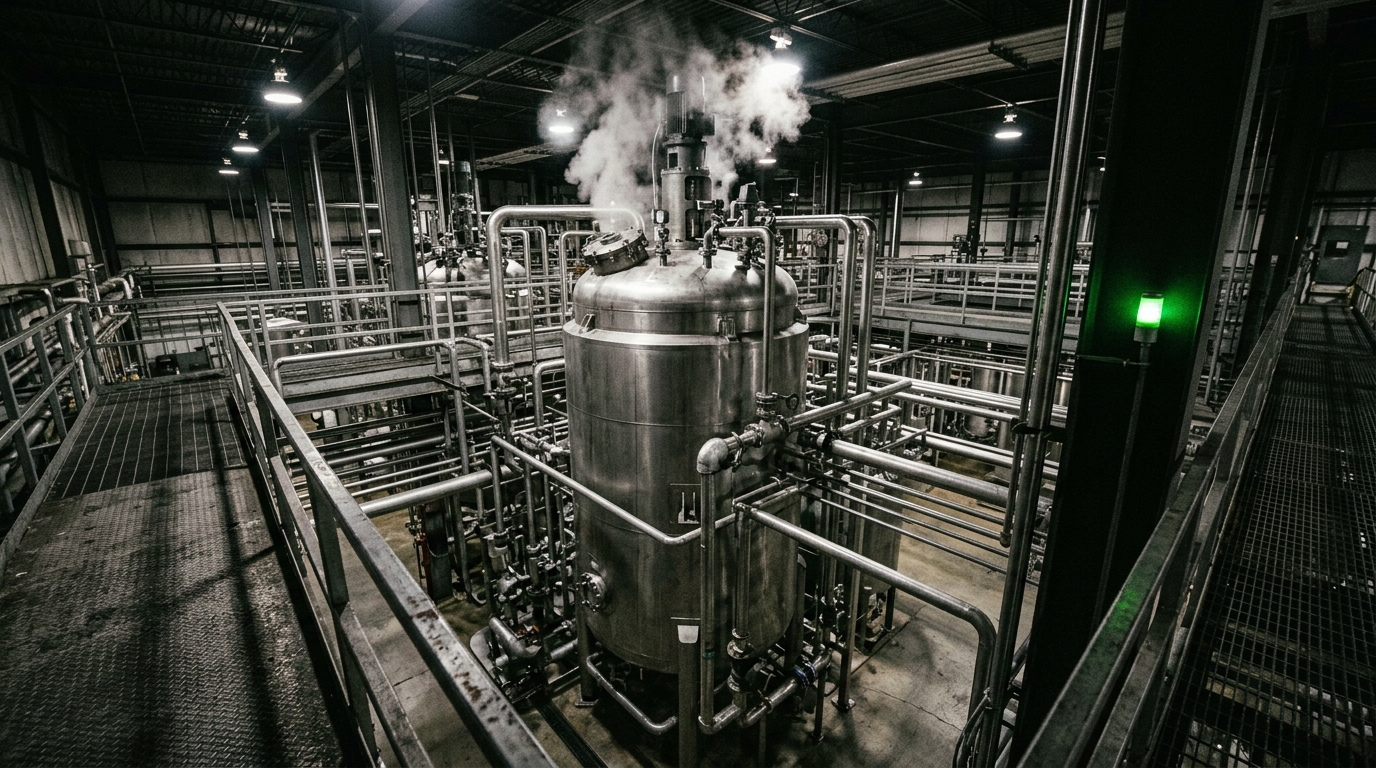
Buyers conflate these. The factory does not. Here is the real spread.
| Contract Manufacturing | Private Label | White Label | |
|---|---|---|---|
| Formula ownership | You own the IP | Factory owns the stock formula | Factory owns the stock formula |
| Up-front investment | $15k-$60k typical for first run + dev | $3k-$15k typical for first run | $1k-$5k typical for first run |
| First-run MOQ | 2,500-5,000u | 500-1,000u | 250-500u |
| Lead time (with dev) | 14-22 weeks | 6-10 weeks | 2-4 weeks |
| Channel defensibility | High — exclusive recipe | Mid — same formula at competitors possible | Low — competitors share the SKU |
Your private-label SKU has proven category fit. Margin is now compressing because two competitors source the same stock. Contract manufacturing is the upgrade.
Investors will not pay multiples on private-label SKUs because there is no defensible IP. Contract manufacturing creates an asset on the balance sheet.
Walmart, Whole Foods, Sprouts buyers want to know you control the formula. They require a manufacturing agreement on file. PL does not satisfy this requirement.
Your differentiation is a specific dose, ratio, or ingredient combination. No stock formula matches. CM is the only path that protects the claim.
Spec, target volume, certification scope, channel mix. We map facility candidates by capacity, certification, and category fit.
Three candidates with audit summaries (most recent FDA inspection result, NSF audit status, capacity availability for your launch window).
Apples-to-apples RFP package out to three facilities. Quotes returned with cost breakdowns, capacity commitments, and lead-time estimates.
Bench-scale pilot at the chosen facility. Stability and homogeneity validation. QA milestones documented in the production schedule.
Full PO. Production scheduled. Lot test, fill, label, case-pack. COA per lot. We track milestones; you don't chase the factory.
Goods land. Reorder cadence locked. Annual volume commitment if it earns better pricing.
// Total14-22 weeks for first run with formula development. 8-12 weeks for reorders on a locked spec.
Contract manufacturing economics live in two places: the first run, where you absorb formula development and tooling, and the reorder cycle, where margin actually compounds. The win is annual volume commitment — facilities will quote 5-15 percent better against a yearly contract than a one-time PO.
| Format | First-run MOQ | Reorder MOQ | Lead time |
|---|---|---|---|
| Capsules (custom formula) | 2,500u | 5,000u | 14-18wk |
| Powders (custom) | 2,500u | 5,000u | 14-20wk |
| Gummies (custom) | 5,000u | 10,000u | 16-22wk |
| Beverages (custom RTD) | 5,000u | 20,000u | 18-22wk |
| Cosmetic serums (custom) | 1,500u | 3,000u | 12-16wk |
/ All ranges are typical industry figures. Final unit cost depends on fill weight, container, label, certifications, run size. Quote against your specific brief.
Every line below has cost a real operator real money. We have seen each of them. Here is the tell, and the fix.
// Tell
Facility commits a window. Two weeks before run, a bigger client takes priority. Your PO slides 4-8 weeks.
// Fix
Get a binding capacity commitment in the contract — not the quote. Pay a small capacity-hold fee if you must. Diversify with a backup facility for SKU 2.
// Tell
Bench-scale pilot was great. Full production lot tastes/looks/feels different.
// Fix
Mandate a pilot run before the first full production. Spec the homogenization, fill rate, and process parameters — not just the recipe.
// Tell
You reject a lot for a sensory issue. Facility argues it is in spec. Stand-off.
// Fix
Define rejection criteria in the master service agreement. Sensory benchmarks. Limits on heavy metals, microbial, label accuracy. Get it in writing before the first PO.
// Tell
Claim language fails a retailer review. You have to relabel mid-run.
// Fix
Run claim language through a regulatory consultant before label print. The cost of a relabel is 5-10x the cost of a 2-hour regulatory review.
// Tell
A competitor launches a near-identical SKU 12 months later. Your CM facility runs both lines.
// Fix
Confidentiality clause with named facility employees who can see the spec. Right-to-audit clause. Trade secret protection on key ratios. None of this is bulletproof — but it is the standard playbook.
Contract manufacturing facilities typically hold a stack of certifications. Verify each one against the issuing body's public registry — facility-claimed certifications without registry confirmation are a red flag.
Required for any US-market manufacturer. Confirm via FDA's registration database.
View source →Mandatory baseline for dietary supplement contract manufacturers.
View source →Third-party. Required for pro-sport and major-retail channels.
View source →Required for any organic claim. Both facility and inputs must be certified.
View source →Food-safety standards required by major food and beverage retailers.
View source →/ All citations verified against the issuing body's published page. Last verified: 2026-05-10.
Six fields. We come back inside 36 hours with three sourcing routes — MOQ, lead time, indicative cost on each.
Open quote form → [02] ToolThe one-page brief format any GMP-aware factory will quote against in 48 hours. Free.
Download PDF →We'll come back inside 36 hours with three sourcing routes, MOQ + lead time + indicative cost on each.