PL operators tired of mockup re-do
You hired a designer. You got a mockup. Print shop quoted you for a redesign before they could print. You need a designer who works in dielines, not Pinterest.
Beautiful packaging that does not print is a tax. Most operators get a pretty mockup from a generalist designer and discover at press time that the file is not production-ready — bleed is missing, color is RGB instead of CMYK, the supplement facts panel does not match the FDA template, or the dieline does not match the carton the facility actually pack-outs to. Packaging design is the discipline of producing a file that walks into a print shop and prints. The mockup is for your investor deck. The dieline is for the line.
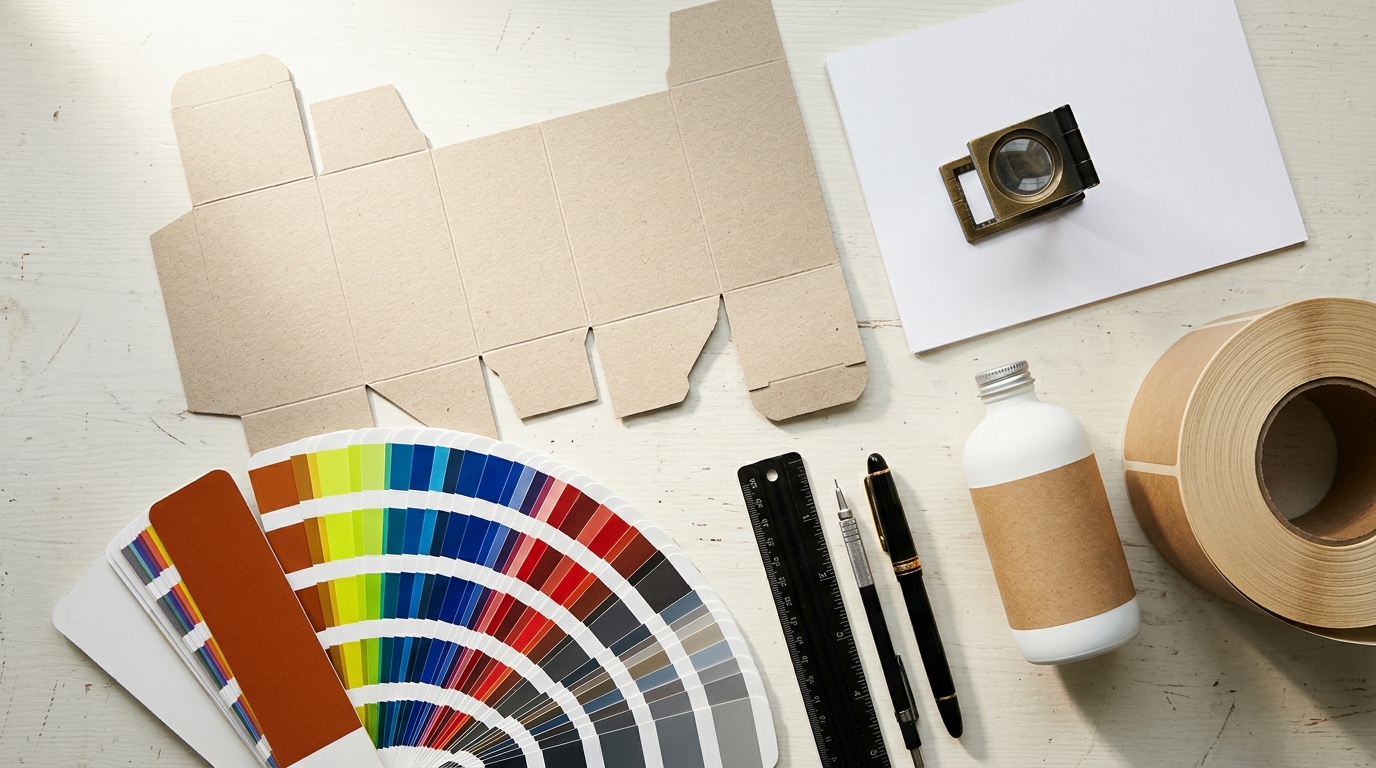
Buyers conflate these. The factory does not. Here is the real spread.
| Packaging Design | Mockup-only design | Generalist branding | |
|---|---|---|---|
| Output | PDF/X-1a, .ai with linked assets, color-managed proof | JPG/PNG mockup | Logo + brand guide |
| Print readiness | Walks into press | Needs production redesign | Needs full packaging system |
| Regulatory zones | FDA-compliant facts panel + claim zones | Decorative only | None |
| Includes color match | Pantone-matched + press proof | Hex code only | Brand color spec |
You hired a designer. You got a mockup. Print shop quoted you for a redesign before they could print. You need a designer who works in dielines, not Pinterest.
A 6-SKU launch needs a packaging system, not six standalone designs. Color hierarchy, claim zones, panel templates that scale to SKU 7 without rebuilding.
Walmart, Whole Foods, Sprouts have specific carton + label specs. You need a designer who reads the buyer's spec sheet and produces against it.
We pull the facility's pack-out spec for the chosen container — exact dimensions, label substrate, fill window, regulatory zone requirements.
Two design directions. Front-of-pack hierarchy, color system, type system, claim treatment. One revision pass.
Print-ready PDF/X-1a. Editable Illustrator with linked assets. Color-managed proof sheet. Barcode scan test.
Press proof from the chosen printer. Color, registration, type sharpness. Sign-off for production.
// Total5-6 weeks per SKU. Multi-SKU lines amortize down to 3-4 weeks per SKU after the first.
Packaging design cost is a function of how many regulatory zones the SKU has, whether it is a multi-SKU system, and whether you need a custom carton on top of the label. The total cost is small relative to a botched print run.
| Format | First-run MOQ | Reorder MOQ | Lead time |
|---|---|---|---|
| Single-SKU label | — | — | 5-6wk |
| Multi-SKU line (3-6 SKUs) | — | — | 8-12wk |
| Carton dieline | — | — | 3-4wk |
| Pouch / stick-pack | — | — | 4-5wk |
/ All ranges are typical industry figures. Final unit cost depends on fill weight, container, label, certifications, run size. Quote against your specific brief.
Every line below has cost a real operator real money. We have seen each of them. Here is the tell, and the fix.
// Tell
Designer delivers a JPG. Print shop says it is not production-ready. Two-week back-and-forth.
// Fix
Specify dieline + PDF/X-1a + linked .ai as deliverables in the brief. Reject anything else.
// Tell
Final print does not match the screen proof. Brand orange prints muddy.
// Fix
Pantone match — not hex. Press proof on Lot 1. File the proof for reorder reference.
// Tell
FDA-compliant panel is missing the bordered box, or font is below 6 pt. Retailer rejects the SKU.
// Fix
Use the FDA labeling guide template. Run the proof past a regulatory consultant if you are not 100 percent sure on the format.
// Tell
Retailer scans your case at receiving. Beep, beep, fail. Inbound delayed.
// Fix
Generate barcode at correct size and contrast. Test scan on a real scanner before sending the file to print.
// Tell
Custom carton dieline arrives at the facility. Carton does not fit the case-pack count or palletization. Production halts.
// Fix
Pull the facility's pack-out spec before the dieline starts. Match the inner-pack count, case dimensions, and pallet build to the facility, not the other way around.
Label compliance is the brand's responsibility — the facility prints what you give them. Verify zones against the FDA labeling guide for the relevant category before signing off.
Required label content for any US-market dietary supplement: statement of identity, net quantity, supplement facts panel, ingredient list, manufacturer info.
View source →Required content for cosmetic labels: identity, net quantity, ingredients, warnings, manufacturer or distributor.
View source →If you claim 'Made in USA,' the FTC standard applies — substantial transformation of US-origin inputs.
View source →Required warning for SKUs sold in California that contain listed substances above safe-harbor levels.
View source →/ All citations verified against the issuing body's published page. Last verified: 2026-05-10.
Six fields. We come back inside 36 hours with three sourcing routes — MOQ, lead time, indicative cost on each.
Open quote form → [02] ToolThe one-page brief format any GMP-aware factory will quote against in 48 hours. Free.
Download PDF →We'll come back inside 36 hours with three sourcing routes, MOQ + lead time + indicative cost on each.