Skip to content
PL Private Label Supply Mfg. · Fulfillment · Brand Ops
[B-04] // Buyer path · B-04

Private label manufacturing for retailers.

You operate a chain or a digital storefront. You watched the house-brand at the next shelf over capture 28% of category-level dollar share. You can move 50,000 units a quarter on a hero SKU. You need a manufacturer that runs at retailer EAU volume, a quality program your buyer can sign off on, and a private-label or white-label structure that does not blow your category margin. Here is the path.

Primary KW: private label manufacturing for retailer Updated 2026-05-10 Intent: Commercial
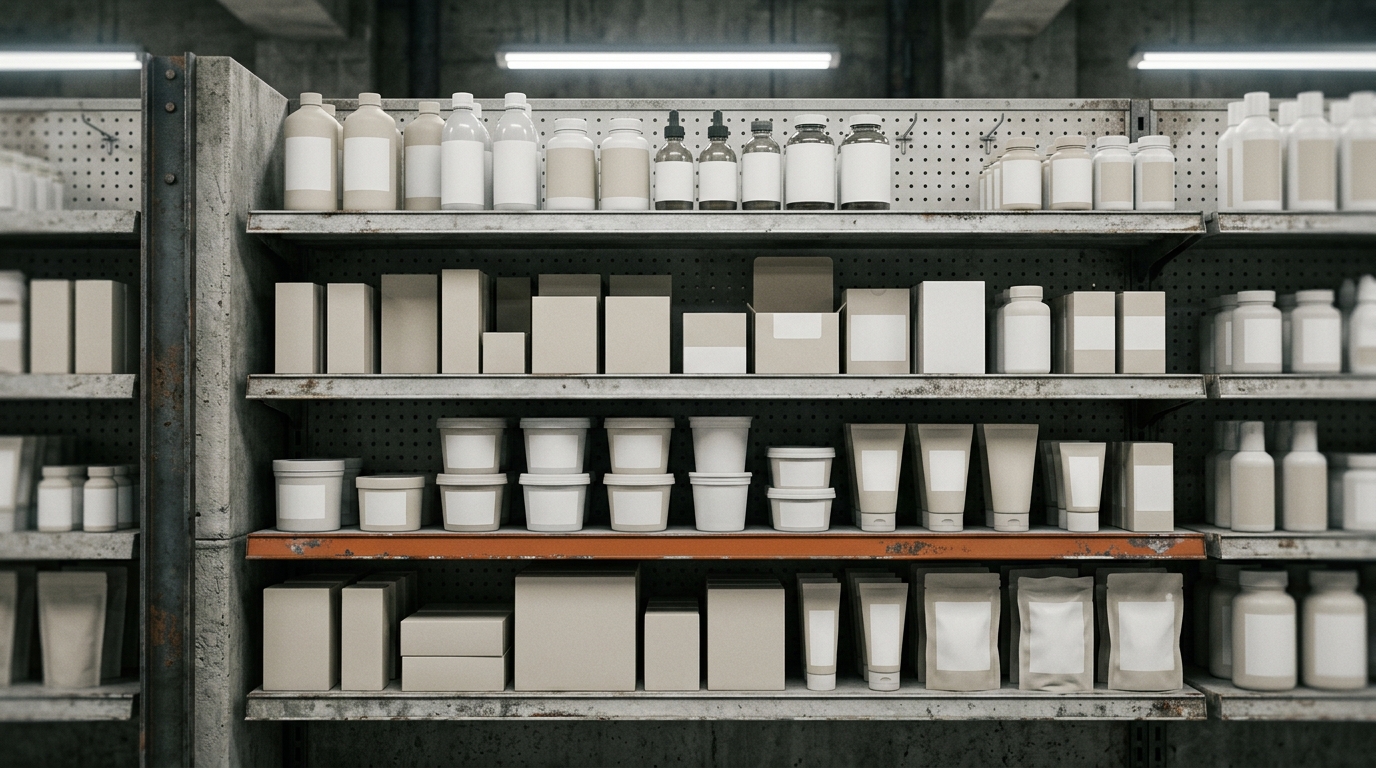
Eye-level view of a retail store shelf with four facings of unbranded white and bone-colored bottles, boxes, tubs, and pouches under cool retail lighting, one rust-orange shelf-edge label strip running across.
[B-04] Buyer Path
[01] // Where you are

Where most retailer category buyers are when they brief us.

01

// Honest read

Your category buyer ran the math. House-brand can hit a 35-50% gross margin where the branded equivalent is running 18-28%. Walmart's Great Value, Costco's Kirkland, Target's Up & Up, Whole Foods 365 — every chain that has run the play has captured material share, and every category that gets re-shelved with a private-label adjacency captures more. You are not deciding whether to do private label. You are deciding which SKUs go first and how to set up a manufacturing supply chain that does not break under EAU.

The category gate is different at retailer scale. You are not picking a factory because they took a 500-unit PO. You are picking because they passed your quality audit (or you ran an audit by Cotecna, SGS, or Eurofins), they have a documented HACCP or HARPC plan, they hold the certifications your category buyer demands (cGMP, ISO 22716, SQF, BRC), and they can ramp from 5,000-unit pilot to 100,000-unit EAU without changing the formula.

The third layer is dual-sourcing. Single-source on a house-brand hero SKU is the line item that takes down a category in a year. Audited primary, audited secondary, formula and label IP held by the retailer, COA standard published in the Manufacturer Quality Agreement. Anything short of that is hoping the primary factory does not burn down.

[02] // The path

The four-step path from category brief to shelf-set.

Retailer-scale private label runs longer than DTC because the audit and dual-source phases are real. Four steps, but the clock is 16-26 weeks.

  1. STEP 01 Weeks 1-3

    Model EAU at three scenarios. Decide structure: white-label vs private-label vs contract.

    Pull category sell-through. Model EAU at low / base / high scenarios for the candidate SKU. Decide structure: white-label (existing stock SKU, your brand on it) for fastest shelf-set on commoditized categories, private-label (you spec, factory produces, may not be exclusive) for differentiated mid-tier, or full contract manufacturing (custom formula, exclusive, your IP) for hero SKUs. Each structure has different MOQ, lead time, audit, and margin profiles. Pick once. Brief accordingly.

  2. STEP 02 Weeks 3-7

    Shortlist three audited manufacturers. Run the quality audit before quote.

    Three manufacturers, all retail-grade. Run the quality audit before requesting a quote — Cotecna, SGS, Eurofins, or your internal QA team. Confirm cGMP / ISO 22716 / SQF / BRC depending on category. Confirm allergen segregation. Confirm batch traceability and lot-coding standard. Confirm capacity headroom (can the factory run 2x your EAU without scheduling conflict). Confirm second-source availability — either a sister facility owned by the same parent, or a separate audited backup factory.

  3. STEP 03 Weeks 7-14

    Pilot 5,000-15,000 units. Consumer-panel test. COA review.

    Pilot run at 5,000-15,000 units. Run a consumer panel test against the branded equivalent — typically 200-400 panelists, blind comparison, ranked on key attributes. Review the COA with category QA. Pull samples from the pilot for shelf-life and stability validation. The pilot is where category buyers decide go / no-go on full EAU rollout. Do not skip the panel test. Internal taste-test is not the same as a 300-person blinded panel.

  4. STEP 04 Weeks 14-26+

    Full EAU production. Dual-source live. Quarterly COA + audit review.

    Sign the EAU contract with the primary, sign a secondary contract at 25-40% of EAU at the backup factory. Set quarterly COA review with the category QA team. Annual audit (or biannual for high-velocity categories). Hold a retainer of finished goods and pre-printed labels at the primary to absorb demand spikes. Set up a SKU-level KPI: in-stock %, OTIF (on-time-in-full), label-defect rate, COA pass rate. Review monthly with the manufacturer.

[03] // Budget

What to budget. Retailer-scale economics.

Retailer-scale private label is not priced in first-PO dollars — it is priced in cents per unit at EAU and basis points of gross margin uplift versus the branded equivalent. Ranges below are industry-typical at the volumes retailers run.

  • [01] Pilot run (5,000-15,000 units): $25,000-$120,000 total depending on category, format, and complexity.
  • [02] Unit cost at EAU (50,000+ units annually): typically 35-55% below the branded equivalent wholesale price.
  • [03] Margin uplift versus branded equivalent: 25-45 basis points at parity retail; up to 60+ basis points if private label retails at 10-20% below branded.
  • [04] Third-party audit (Cotecna, SGS, Eurofins): $4,000-$12,000 per facility per year for an annual audit program.
  • [05] Quarterly COA review (third-party verified): $200-$800 per batch reviewed.
  • [06] Consumer panel testing per SKU: $8,000-$25,000 depending on panel size and methodology.
  • [07] Label print tooling and stock holding: $2,000-$15,000 per SKU one-time; pre-printed label inventory typically held at the factory.
  • [08] Dual-source qualification (second factory audit and pilot): same as primary, treat as a parallel workstream not a backup.
  • [09] Recall reserve: 0.5-1.5% of EAU revenue, held against potential category recall events.
  • [10] Annual third-party assay verification across SKUs: $20,000-$80,000 across the house-brand portfolio.

Most retailers under-budget the audit and dual-source program by 60-80% on the first house-brand rollout. The factory will quote you on unit cost. Your real cost is unit cost plus audit plus dual-source plus consumer panel plus recall reserve. Build the model with all of it.

[04] // Stuck points

Where retailer private-label programs actually get stuck.

Each line below has cost a retailer either a category quarter or a recall event. Pre-empt them in the agreement.

STUCK 01

// Tell

Primary factory had a fire / power outage / regulatory hold and your hero SKU is out of stock for nine weeks.

// Fix

Dual-source from day one. Secondary contract at 25-40% of EAU, audited and pilot-validated against the same formula. The cost of dual-source is 2-5% of category margin; the cost of a nine-week out-of-stock on a hero house-brand is 18-30% of category revenue.

STUCK 02

// Tell

Sister-SKU on a different shelf turned out to be made at the same factory with the same actives, and a recall on one took both.

// Fix

Map factory-to-SKU exposure across the entire house-brand portfolio. No single factory should run more than 30-40% of the portfolio. No single category should run on a single audited site without a documented secondary.

STUCK 03

// Tell

House-brand SKU launched at parity with branded and consumer panel scores were below the branded equivalent.

// Fix

Pre-launch consumer panel. Blind, 200-400 panelists, ranked on the attributes that actually drive repurchase. Score within 5% of the branded equivalent before authorizing a category-wide shelf-set.

STUCK 04

// Tell

Manufacturer Quality Agreement was signed three years ago and never refreshed; the COA standard is out of date for the current regulatory environment.

// Fix

Annual MQA refresh. The MQA is the document a QA buyer reviews when something goes wrong; it is the document a regulator looks at first. Treat it as a living document, not a one-time signature.

STUCK 05

// Tell

Category buyer wants to move EAU to a new factory with a 9% per-unit discount.

// Fix

Audit the new factory. Run a parallel pilot. Hold the existing primary on the SKU until the new factory passes both. Do not switch EAU on a price quote alone. The on-shelf cost of a transition mismatch is 30-90 days of category disruption.

[05] // Where we fit

Where Private Label Supply fits.

We work with category teams that have not run a house-brand program before and with established retailers looking to add SKUs without rebuilding the sourcing function. We translate category briefs into a one-page manufacturer brief, shortlist three audited factories that match the EAU range and category certifications, scope the audit program with a third-party auditor, and review the Manufacturer Quality Agreement before category counsel signs. Flat sourcing fee per SKU. You pay the factory directly. We do not take a margin position.

[06] // Related guides

What to read next, in order.

Every link below was selected because it appears in the spec flow for this buyer path. Services, industries, journal posts, and glossary entries — same content base, indexed for your stage.

[07] // FAQ

Common questions on this path.

Should I start a house-brand program with white label or private label?

White label is faster (4-8 weeks to shelf) and lower-risk on commoditized categories — basics, staples, the bottom-shelf price-pointed SKU. Private label or contract manufacturing is slower (16-26 weeks) but defensible and margin-accretive on hero categories and mid-tier differentiation. Most house-brand programs run both structures across the portfolio.

How much margin uplift can a house-brand realistically capture over branded?

25-45 basis points of gross margin at parity retail pricing. Up to 60+ basis points if the house-brand retails 10-20% below branded and the manufacturing supply chain is stable. Mature house-brand programs (5+ years, multi-category) often run higher because the audit and tooling costs are amortized.

Do I need to dual-source every house-brand SKU?

Every hero SKU and every SKU running above ~15% of category sell-through, yes. Long-tail SKUs (slow-velocity, low-share) can run single-source if you accept a 4-6 week recovery window on a primary outage. Map the portfolio. Set the dual-source policy by velocity tier.

What audit standard should I require?

Category-dependent. Supplements: cGMP per 21 CFR 111 plus NSF or NPA certification. Beauty: ISO 22716 plus MoCRA registration. Food and beverage: SQF or BRC plus FDA Food Facility Registration. Pet supplements: AAFCO state-level review plus cGMP at the production facility.

Who owns the formula and the label IP?

Retailer should hold both. The MQA should state the formula is the retailer's exclusive property for the agreement term (and ideally indefinitely with appropriate consideration), and the label artwork and dieline are retailer-owned. The factory may not produce close-derivative formulas for other parties.

How do I handle a recall on a house-brand SKU?

Recall reserve at 0.5-1.5% of EAU revenue, plus traceability protocol in the MQA (lot-level pull capability within 24 hours), plus a documented decision tree for voluntary vs FDA-initiated recall. Most house-brand programs that survive a recall do so because the traceability protocol existed before the event.

Can we get exclusivity on a custom formula?

Yes. The MQA exclusivity clause should state the factory may not produce, sell, or license the formula or any close derivative to any other party for the agreement term (typically 5-10 years for retailer-scale contracts). Without exclusivity, the formula is effectively a private-label SKU and your hero positioning collapses.
[REF] // References

Authority sources for this path.

/ All citations verified against the issuing body's published page. Last verified: 2026-05-10.

// Next step

Brief the house-brand SKU.

Tell us category, EAU range, audit posture, dual-source policy, and shelf-set target. We will come back inside 36 hours with three audited sourcing routes and a draft Manufacturer Quality Agreement framework.